
Renting vs Buying in Dubai: When Does Investing in Your Dream Interior Actually Pay Off?
Table of Contents
- Is It Better to Rent or Buy in Dubai? The Honest Answer
- The Benefits of Buying Property in Dubai vs Renting
- When Renting Still Makes More Sense
- Buying Property vs Renting in Dubai: Cost Comparison
- The Interior Question Most Rent vs Buy Maths Ignores
- Your Rent or Buy Checklist
- Working With an Interior Design Consultant After You Buy
- Renting vs Buying in Dubai: The Final Answer
- Is it cheaper to rent or buy in Dubai?
- How many years do you need to stay in Dubai for buying to make sense?
- What hidden costs come with owning a home in Dubai?
- Can tenants renovate a rented apartment in Dubai?
- Do interior upgrades increase property value in Dubai?
- Should I buy ready or off-plan if I plan to live in it?
Many people come to Dubai for a job, a better quality of life or just to experience the city for a few years. Some leave within six months, but most stay for years.
A friend of mine in Dubai told me how his landlord handed him an eviction notice just three months after he moved in. He felt stuck and regretted all the money he had spent on rent. He says dealing with constant rent hikes was exhausting, until he finally bought his own place.
But buying a home feels scary too. What if you lose your job? What if property prices drop? The math is confusing, the upfront fees are huge, and no one tells you how much you will need to spend to fix up the interior design once you get the keys.
In this blog, I’ll answer the big question of renting vs buying in Dubai: should you keep renting, or is it time to buy? And if you buy, how do you create a beautiful home that adds value without throwing money away?
So keep reading to find out exactly how to make the right choice for your family, your wallet, and your future living space.
Is It Better to Rent or Buy in Dubai? The Honest Answer
Is it better to rent or buy in Dubai? The short answer is that it depends mostly on how long you will stay and how secure your job is.
Residents sharing their experiences on Reddit mostly agree that buying makes sense if you stay around 4 to 7 years. So if you plan to live in Dubai for more than five years, buying is usually the smarter money move.
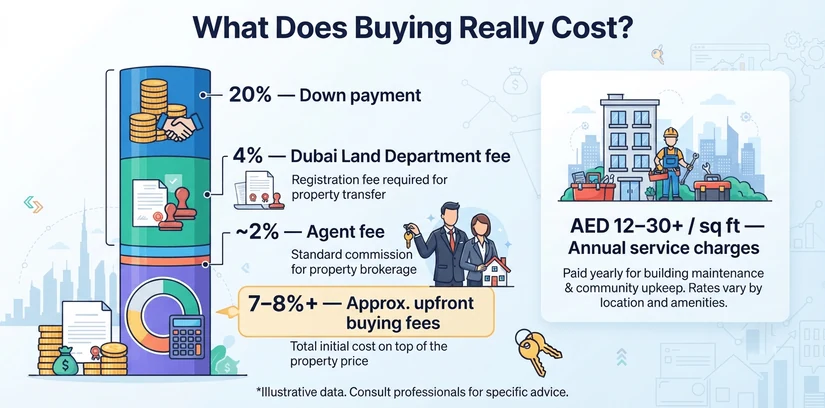
Why? Because buying a home takes a lot of cash upfront. You pay a 4% Dubai Land Department fee and around 2% to the real estate agent. If you buy and then leave the country two years later, the price probably hasn’t grown enough to cover those fees.
You would be at a loss. But if you stay for seven years, the money you save by not paying rent easily covers those starting fees.
What to do: Ask yourself honestly today: “Will I still be living in Dubai five years from now?”
The Benefits of Buying Property in Dubai vs Renting
When I look at the benefits of buying property in Dubai vs renting, peace of mind comes first.
When you own your home, you are protected from crazy rent hikes.
Paying rent is like giving away your apples: once you eat them, they are gone. Buying a home is like planting an apple tree.
Every mortgage payment is like watering that tree. Over time it grows and you own it, and you only have to worry about one monthly mortgage payment instead of several rent cheques. This is called building equity.
The biggest joy is freedom. You can paint the walls green, open up the living room or change whatever you like, with the right building approvals for major works. As an owner, a rising rental market no longer changes your living situation.
The market data backs this up. According to Knight Frank market data, residential sales in Dubai reached AED 544.2bn in 2025, up 25% year on year, and prime prices passed AED 4,300 per sq ft by the fourth quarter.
What to do: Write down the total rent you have paid over the last three years. Seeing that number can push you to start saving for a down payment.
When Renting Still Makes More Sense
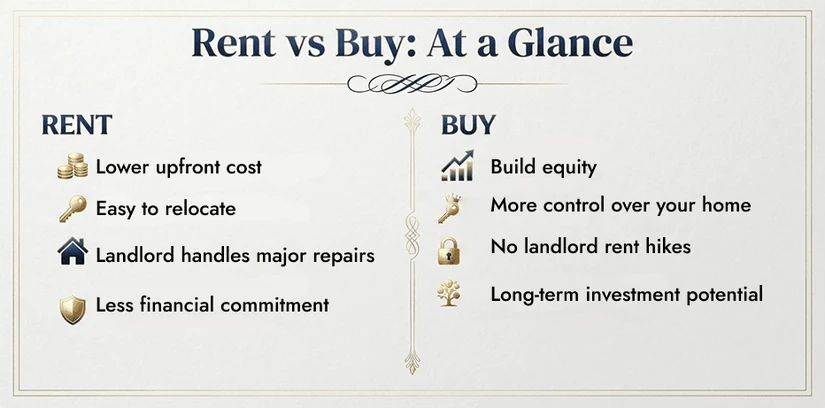
Owning is great, but when it comes to renting vs buying in Dubai, renting is sometimes the better choice.
If your income is not stable, or you work in an industry where job losses are common, a mortgage is very stressful. One owner shared on Quora how he lost his job twice after buying a house, and the pressure to pay the bank was huge.
If you do not like your loud neighbours or if you change jobs to the other side of town, you can just pack up and move, as renting gives you flexibility.
Some people also prefer to invest their cash in stocks or their own business instead of locking it in a house. And if you buy an off-plan home that is not built yet, you risk long delays.
Don’t rely on online advertisements, as the build quality and facilities in new buildings may not match what was advertised.
Buying Property vs Renting in Dubai: Cost Comparison
Before you decide, you must understand the real numbers. Here is a buying property vs renting in Dubai cost comparison so you can see the true costs side by side.
| Cost Type | If You Rent | If You Buy |
|---|---|---|
| Upfront Cash | Security deposit (usually 5% of rent) | 20% down payment (for expats) |
| Government Fees | Ejari fee (around AED 220) | 4% Dubai Land Department fee + admin fees |
| Agent Fees | Around 5% of yearly rent | Around 2% of the total property price |
| Monthly Payments | Rent cheques | Mortgage payments (rates move with base rate later) |
| Building Upkeep | Landlord pays for the building | You pay annual Service Charges (AED 12-30+ per sq ft) |
| Utilities Extra | 5% Dubai Municipality housing fee (on your annual rent) | 5% Dubai Municipality housing fee (on the RERA average rental value, for expat owners) |
| Repairs | Landlord pays for major fixes | You pay for all maintenance and home insurance. |
| Making it Yours | Buying loose furniture and rugs | Full renovation and interior design costs |
The upfront fees for buying add up to around 7% to 8% of the property price, on top of the 20% down payment that the Central Bank of the UAE requires from most expat first-time buyers. Mortgage rates are not fixed forever: after the introductory period, they move with the bank’s base rate.
What to do: Talk to a certified mortgage adviser to understand your exact numbers.
The Interior Question Most Rent vs Buy Maths Ignores
When weighing up renting vs buying in Dubai, most people focus entirely on mortgages and government fees and ignore the big hidden cost of the interior.
The maths changes completely depending on who owns the walls. If you buy, every dirham spent on permanent upgrades like custom flooring or a new kitchen is an investment that can raise the home’s future resale value.
If you rent, the same renovation is a cost, because Dubai law requires you to return the property in its original condition. You pay once to install it and again to remove it or paint back to standard off-white when you leave.
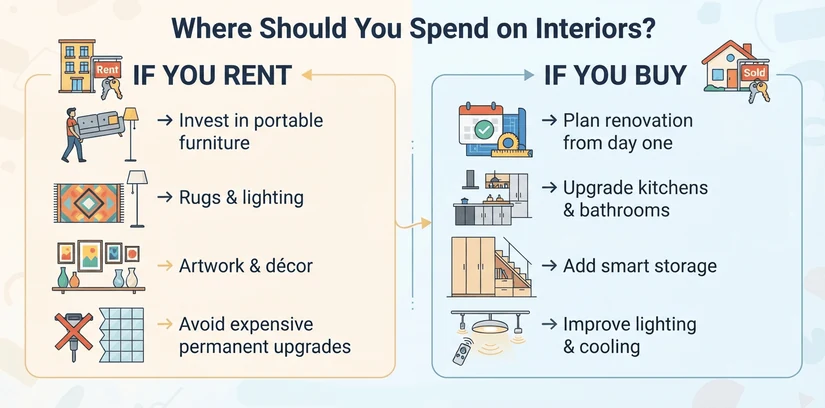
So as an owner, invest in the structure itself to build equity. As a renter, focus on movable decor like sofas and rugs that you can pack up and take with you, and avoid furniture that won’t fit your next layout.
Renters: Spend on What Moves With You
If you rent, your rule is basic: never spend big money fixing someone else’s house.
If you want to paint the walls, drill big holes, or upgrade the bathroom, you usually need the landlord’s written permission. And worse, anything you spend stays behind when you move. If you buy a beautiful custom kitchen counter, you are just giving a gift to your landlord.
Spend on things that fit in a moving box: a comfortable, good-quality sofa, a large rug to cover an ugly floor, plug-in lamps and big art pieces. They make the place yours, and they are all portable.
Owners: Why Your Interior Needs a Plan From Day One
When you buy your first home, furnishing and fixing it is a near-certain cost. Many buyers spend all their money on the down payment and have zero left for the inside of the house.
One long-time owner shared a sad story on a Dubai discussion forum. They bought a house but had no money left to fix it. Over the years, the property got old. Doing renovations while living inside the house was too messy and tiring.
They said, “We couldn’t upgrade or change our kitchen and bathrooms, and felt like our living standards dropped,” especially when they saw shiny newer homes coming onto the market.
Ownership can feel like a downgrade if you have no renovation plan. That is why you should keep a budget for interior design styles and upgrades from day one.
Market reports show Dubai homeowners spending up to $5.4m renovating luxury villas rather than moving. Keeping an interior budget from the start means your new home won’t begin to feel old and tired.
Upgrades That Actually Pay Off for Owners
Transforming your space is a real benefit of owning. One resident noted that owning meant an “improved quality of life in one’s own home, as it can be slowly personalised to one’s needs, which typically does not happen in tenanted apartments.”
If you are looking to buy, the following upgrades will give you the best return for your money.
- Kitchens and bathrooms: Refreshing these rooms is one of the most reliable ways to add value. If you ever plan to sell or rent out the home, a good-looking kitchen helps you earn more.
- More storage: Built-in wardrobes and clever storage are highly valued in Dubai, because many apartments don’t have enough.
- Layout changes: One buyer in JVT planned to add a bedroom to a townhouse by converting a mezzanine. Bigger changes like extensions need a No Objection Certificate (NOC) from the developer.
- Better lighting and cooling: Upgrading finishes and AC systems to keep the home cool in Dubai’s heat will save you a lot on electricity.
These upgrades pay off in daily comfort, and they raise both the rental appeal and the resale value of your home.
Upgrades That Rarely Pay Off
Don’t waste money on very personal finishes or passing trends. If you put bright coloured tiles everywhere, the next buyer may not like them. Avoid anything hard to clean or maintain in a dusty climate, and keep your big choices simple and high quality.
What to do: If you buy, set aside a yearly percentage of the property’s value for renovation and maintenance, as one homeowner on Quora suggests, so your home never feels outdated.
Your Rent or Buy Checklist
Still not sure about renting vs buying in Dubai? Grab a pen and answer these six simple questions:
- How long will I stay in Dubai?
- Is my monthly income stable and safe?
- Do I have a good emergency fund?
- Can I cover the high upfront costs without draining all my savings?
- Am I buying a ready home, or an off-plan home that might get delayed?
- Have I budgeted enough money for furnishing and the interior design?
What to do: If you answered “no” to most of these questions, keep renting, save your cash and buy good furniture you can take with you.
Working With an Interior Design Consultant After You Buy
Partnering with a top interior design consultant helps you set a realistic budget from the start, so you don’t run out of cash halfway through. A professional will guide you through the luxury design process and help you avoid structural mistakes that are expensive to fix later.
If you are buying soon, it is worth learning how to choose an interior design consultant and speaking to one from day one, so your new home becomes a comfortable, luxurious space.
Renting vs Buying in Dubai: The Final Answer
People often type this exact question into search engines and platforms: “Should I rent or buy in Dubai if I have the budget and plan to stay?”
My advice: rent if you are only in Dubai for a short time and need flexibility. Buy if your stay is confirmed, your job is secure and you are ready to build long-term equity instead of paying a landlord. That is the honest bottom line on renting vs buying in Dubai.
If you are moving from tenant to homeowner, remember that securing the property is only step one. Planning your interior upgrades ahead of time makes sure your new house truly becomes the home you want.
Ready to get the most out of your property? Contact our interior design consultants today to plan how to turn your empty floor plan into a functional, luxury living space.
FAQs
Is it cheaper to rent or buy in Dubai?
In the short term, renting is cheaper because there are no big fees. In the long term (over 5 years), buying is usually cheaper because you build your own equity instead of paying a landlord.
How many years do you need to stay in Dubai for buying to make sense?
Most residents and real estate experts agree that staying for at least 4 to 7 years makes buying the smarter financial choice, because it gives you time to cover the high upfront purchase fees.
What hidden costs come with owning a home in Dubai?
Owners pay annual service charges for the building, the housing fee on the DEWA bill, home insurance and all maintenance and repair costs.
Can tenants renovate a rented apartment in Dubai?
Usually not without permission. Tenants need the landlord’s approval for changes like painting or drilling, and any money spent on big upgrades stays with the property when you leave.
Do interior upgrades increase property value in Dubai?
Yes. Smart upgrades to kitchens and bathrooms, built-in storage or an extra bedroom can raise both the resale value and the rental price of a property.
Should I buy ready or off-plan if I plan to live in it?
If you need a place to live right now, buy a ready property. Off-plan homes cost less upfront but often face construction delays, which can mean paying rent for years longer.
