

Imagine handing a large amount of your hard-earned money to an interior design consultant to build your dream home in Dubai. You are smiling, excited as the construction begins, and counting down the days until you move in.
Then comes a long communication gap, and silence.
You call your consultant, but nobody picks up, and days turn into weeks. You visit the house and your heart sinks. The floors are smashed up, dust is everywhere, not a single worker is on site, and nothing has progressed.
A few days later your phone buzzes with a message from the consultant. “We made a math mistake on the bricks and cement. Pay us an extra AED 45,000, or we cannot progress and your house will stay incomplete.”
How would you feel?
Several people have posted about exactly this on Reddit, saying they bought a home in Dubai and were ghosted after consultants accepted large down payments, sometimes 50% to 80% of the cost.
After getting paid, the work slows or stops altogether, because the consultant was using client deposits to cover an older failing project or pay off day labourers.
The good news is that almost every one of these interior design scams in Dubai shows warning signs before you ever sign a contract or pay a deposit. Here are the red flags to watch for.
Do You Really Know What a Design Consultant Does?
Many homeowners assume an interior design consultant simply picks out paint palettes, furniture and decorative finishes. In reality a legitimate consultant acts as your technical project director. If you do not know which deliverables they owe you, it is impossible to tell whether you are paying for real expertise or an overpriced mood board.
A qualified consultant is responsible for technical and regulatory scope, including:
- Site surveys and spatial planning: conducting precise measured site surveys, converting your lifestyle requirements into scaled layout plans, and creating 3D schematic visualisations.
- Statutory approvals and MEP coordination: working within Dubai’s strict building codes by managing mechanical, electrical and plumbing documentation for submission to entities like Dubai Municipality, Civil Defence, or master developers such as Emaar and Nakheel.
- Detailed procurement schedules: producing comprehensive schedules for finishes, fixtures, joinery specifications and sanitary ware, complete with exact measurements, material grades and execution standards.
If you want the full picture of what each stage should produce, our guide to the interior design process sets out the deliverables from brief through to handover.
Hiring Blindly? Know Your Space Requirements First
Before you invite anyone to pitch ideas for your home, you need absolute clarity on what your space actually needs. Walking into a first consultation without that knowledge makes you easy prey for dishonest consultants who inflate the scope to justify a much larger fee.
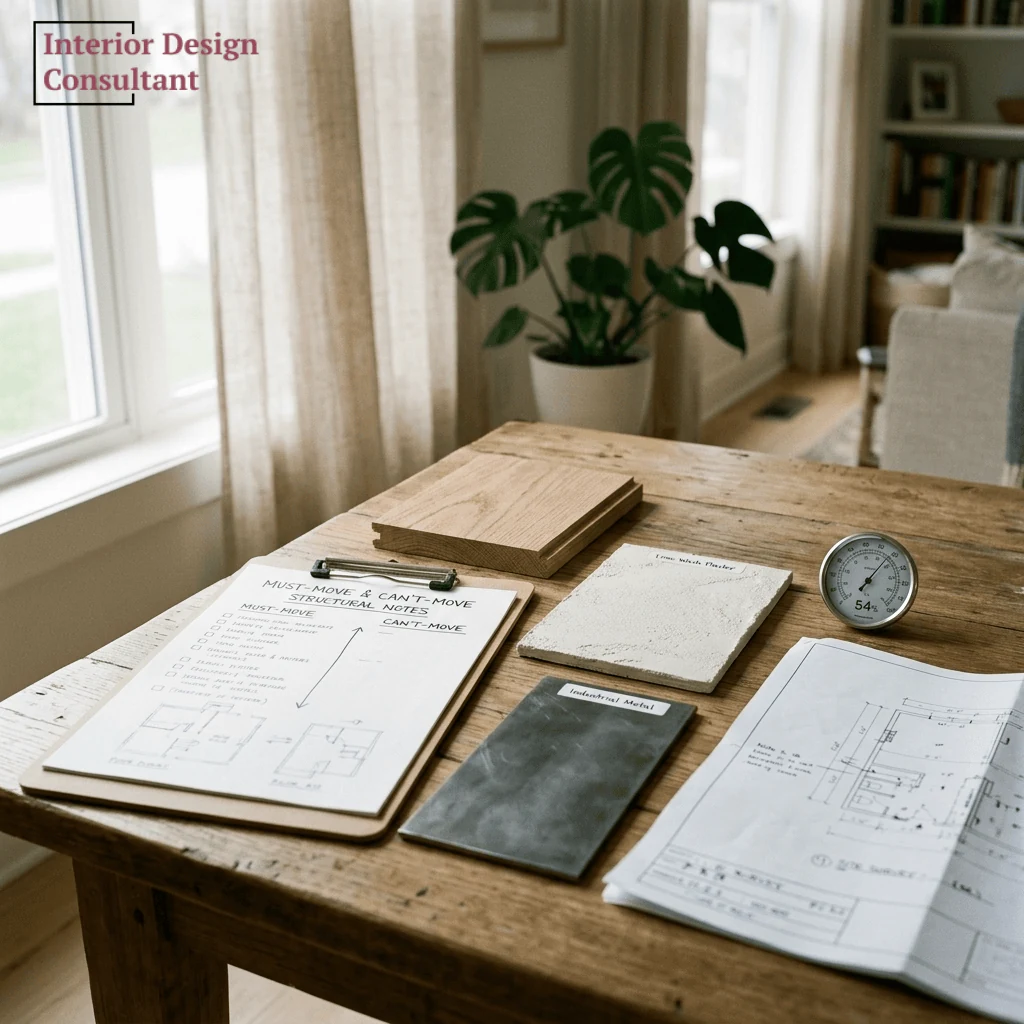
How to Recognise and Define Your Space Requirements
Define your project boundaries before you sit down with a consultant. Set up an initial briefing meeting, but keep the reins in your hands using the points below.
- Start by auditing your structural and MEP boundaries. What can be moved, and what is impossible to move?
- Determine your functional style by collecting tangible reference samples of finishes you like, such as Japandi oak joinery, modern industrial, or Mediterranean lime wash. If a consultant cannot immediately tell you how those finishes perform in Dubai’s summer humidity, they lack operational experience.
- As a safeguard, make it clear from the first meeting that a full site survey must be carried out before any designs are issued. Make sure all authority approvals from Dubai Municipality, Civil Defence, and developer NOCs are obtained on the firm’s account.
- Insist that you will not pay the final instalment until you have seen the results of a detailed third-party or joint snagging inspection, so that maintenance issues, leaks and lighting faults are sorted out first.
The Pre-Deposit Defence: Vetting and Deposit Safeguards
A friend of mine who managed residential fit-outs across Dubai learned this lesson the hard way. Early in his career he signed off on a 40% upfront mobilisation advance to a consultant for a villa project in Arabian Ranches.
Within twelve days the contractor gutted the ceiling, pulled their workers off site, and used his client’s cash to cover payroll deficits on an unrelated commercial project in Al Quoz. It took four months of formal legal notices and consumer protection mediation to salvage the project.
Under standard international procurement principles such as FIDIC (International Federation of Consulting Engineers) conditions, and under normal UAE fit-out practice, advance mobilisation payments are generally capped between 10% and 15%, secured against tangible deliverables.
When a consultant demands an advance exceeding 20% to 30% without an Advance Payment Guarantee or escrow protection, your exposure multiplies. Once an operator pockets their entire profit margin before breaking ground, the financial urgency to solve on-site delays disappears.
Insist on a milestone schedule tied to tangible deliverables, along these lines:
- Initial deposit: 10% to 15% maximum on contract signing.
- Concept approval: around 20% to 25%, only after you approve scaled 2D space plans and 3D perspectives.
- Technical and tender package: 30% to 35% on receipt of complete technical drawings, MEP layouts and an itemised BOQ.
- Final balance: released only when you have the results of the final inspection.
Contract Clauses: Three Guarantees You Need
A standard two-page quote is not a legal contract. A luxury interior design service provides a comprehensive consultancy agreement that spells out every responsibility.
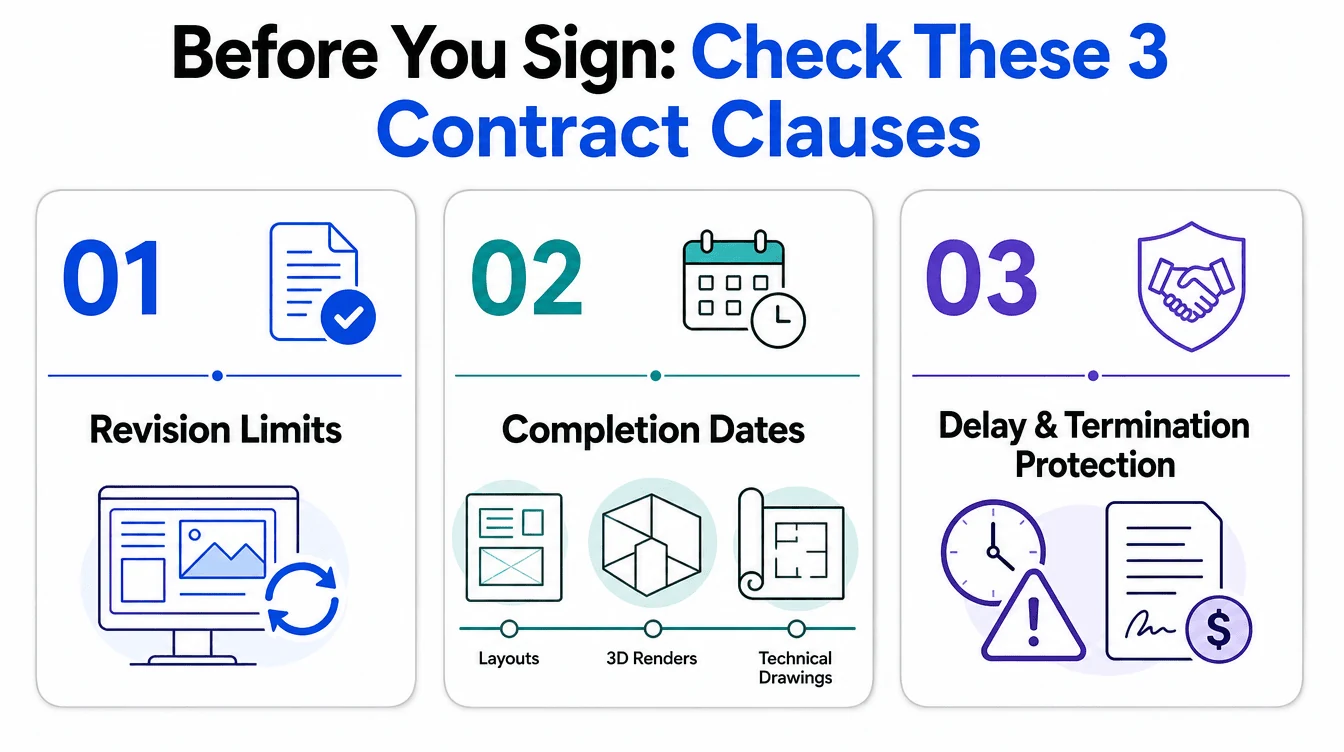
Your contract must include:
- How many rounds of design are included at each stage, for example up to three room revisions before further charges apply.
- Precise completion dates for preliminary layouts, 3D renders and technical drawings. Vague wording such as “work shall commence shortly” must be avoided.
- A provision requiring one week’s written notice identifying any delayed part, with a charge for unexcused delay beyond an agreed grace period, for example 0.5% per week on the final invoice.
- A clause stating that if the consultant has not delivered the contracted design documentation 30 days past the completion date, the contract is terminated and all unearned deposit funds must be returned within 10 business days, backed by statutory terms under UAE Federal Decree-Law No. 5 of 2023 on Consumer Protection.
According to a report by The National, loose invoicing in Dubai’s interior design trade is a frequent tactic used by opportunistic companies to abscond with deposits and bridge their own cash-flow gaps.
Verification Checklist: Trade Licence and Past Site Audits
Never accept an invoice or contract without verifying the consultant’s commercial registration. Anyone can print a business card or launch a website, but operating legally in the emirate requires proper licensing.
| Verification item | What to look for | Red flag warning |
|---|---|---|
| DED or free zone licence | “Interior Design Services” or “Design Consultancy” | Commercial activity listed only as “General Trading” or “E-Commerce” |
| Corporate bank account | Account title matches the exact registered trade name | Consultant requests deposit transfer to a personal bank account |
| Physical office location | Verified commercial address with a dedicated desk or office | Operates strictly out of temporary co-working day passes or coffee shops |
| Active site audits | Two or three ongoing, verifiable sites you can physically inspect | Excuses about client confidentiality whenever you ask to visit live projects |
Check the legal status of any consultant through the official UAE business licence directory. Mainland consultants can be confirmed directly through the Invest in Dubai portal.
Under the same consumer protection law, suppliers are legally obliged to provide transparent contracts, accurate service details, and to honour agreed performance standards.
The Hidden Fee Trap: Paying for Services That Should Be Free
Dishonest consultants advertise unrealistically low base rates to lure you in, then hit you with surprise fees for basic tasks once you have paid your commitment deposit.
The defence is simple. Demand a fully itemised breakdown of services before you transfer any funds.
Average Design Quotation Prices in Dubai
To spot an artificially inflated invoice, you need to know current market reference values. Consultancy fees in Dubai depend on the scope of work, the property type, and whether you are hiring design only or full project supervision.
| Property type and project scope | Typical property size | Average market fee (design only) | Average market fee (design plus supervision) | Payment model |
|---|---|---|---|---|
| 2-bed apartment (cosmetic or styling) | 1,100 to 1,500 sq ft | AED 15,000 to AED 25,000 | AED 28,000 to AED 42,000 | Lump-sum fixed fee |
| 3-bed villa (full remodel: MEP, joinery, 3D) | 2,800 to 4,000 sq ft | AED 35,000 to AED 60,000 | AED 65,000 to AED 95,000 | Per sq ft (AED 12 to 25) |
| Luxury villa (full architecture and interiors) | 6,000 to 10,000+ sq ft | AED 90,000 to AED 180,000 | AED 190,000 to AED 320,000 | 8% to 12% of total fit-out budget |
| Commercial or executive office shell and core | 2,000 to 5,000 sq ft | AED 25,000 to AED 55,000 | AED 50,000 to AED 85,000 | Per sq ft (AED 15 to 30) |
When you review your quotation, make sure you are not paying extra for services that belong in standard overhead:
- Initial site surveys and measurements: routine site verification is part of mobilisation. Never pay a separate laser assessment fee.
- Material sample boards: trade suppliers give fabric, tile and stone swatches to designers free of charge.
- NOC dossier compilation: compiling drawings for developer or municipality approval is basic design work.
- Primary showroom walkthroughs: guiding you through one or two key supplier visits for tiles and sanitary ware is standard practice, not an hourly add-on.
- Preliminary 2D plan revisions: initial space planning routinely includes two or three revision rounds. Minor layout tweaks should never trigger variation penalties.
- Procurement markup double-dipping: a consultant should not pocket a 20% to 35% trade discount while also billing you a sourcing fee on retail prices.
- Handover snagging inspection: compiling the final defect list to force contractor fixes is core project management, not a paid extra.
Unmasking the Red Flags: How to Spot a Rogue Consultant Early
Shady consultants rarely hide their habits completely. If you know what to look for, the warning signs are visible long before you sign a deposit cheque.
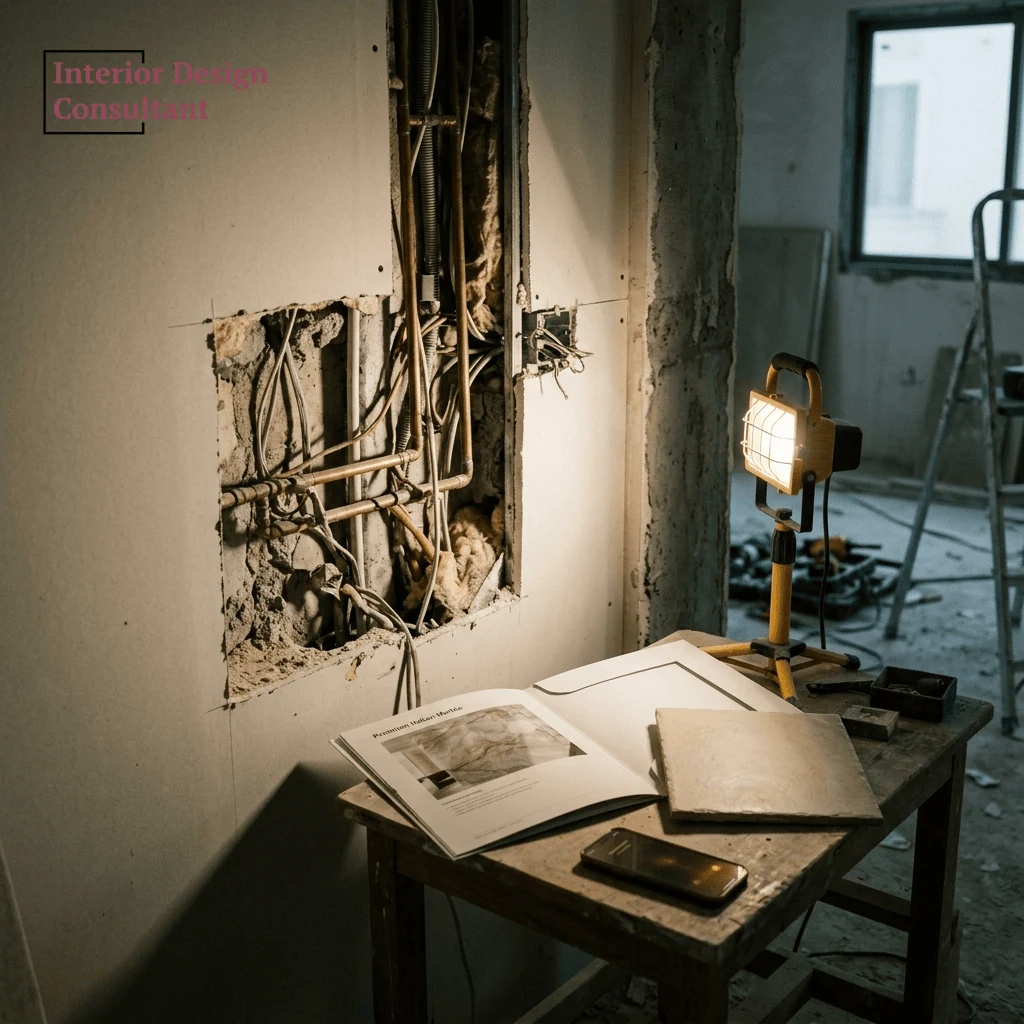
The Vanishing Act: What to Do When Your Consultant Starts Ghosting
Ghosting rarely happens all at once. It starts with small shifts in behaviour:
- WhatsApp messages go from 10-minute replies to 36-hour delays.
- Repeated excuses about family emergencies, illness, or municipal technical glitches.
- Scheduled weekly site coordination calls cancelled at the last minute.
When communication slows down, act immediately:
- Send a formal notice and stop relying on informal WhatsApp chats. Send an official email setting a hard five-business-day deadline to deliver outstanding milestones as agreed in the contract.
- Do not release any further payments, whatever the claims about supplier demands or material orders.
- If the deadline passes with no resolution, submit an official dispute through the Dubai Economy and Tourism consumer rights portal. Their dispute resolution teams mediate commercial breaches, provided you have a valid contract and bank receipts. For unlicensed operators or outright theft, submit a claim through the Dubai Police e-Crime service.
Fake Portfolios and Social Media Illusions
A striking Instagram feed or a polished website does not prove capability. Rogue operators regularly pull high-end renders from Behance, Pinterest and foreign design studios, then claim them as their own Dubai projects.
How to verify a portfolio in five minutes:
- Save portfolio images from their website or social accounts and run them through Google Images or TinEye. If a project supposedly in Emirates Hills appears on a Miami or Moscow studio page, end discussions immediately.
- Anyone can download a rendering. Ask to see the construction drawings, lighting layouts and MEP schematics that go with that exact project. A fake consultant will stumble over technical questions.
- Ask to speak with two clients who finished projects with them in Dubai in the last 12 months. Rogue operators will claim non-disclosure agreements prevent them from sharing any references.
Site Management Red Flags
When a consultant also manages fit-out execution, rogue behaviour often shows up on site:
- Installing drywall or ceiling boards before rough-in plumbing and electrical conduits have passed inspection. This shortcut hides substandard work behind closed surfaces.
- No daily logbook. Professional sites record worker attendance, inspections and material deliveries. A rogue operator runs disorganised sites with no paper trail.
- Altering bulkhead heights, reducing joinery depths, or shifting power points without issuing a written Site Instruction or Variation Order. These changes are usually made to save time or cover up planning errors.
Material Sourcing Rackets and Cheap Finish Traps
A common way unethical operators make money is by charging you for premium specifications while installing cheap alternatives.
- Specifying Italian porcelain tiles or European sanitary ware in the presentation, then buying unbranded alternatives from local industrial areas without telling you.
- Demanding extra funds halfway through the project by claiming material inflation or exchange rate movement. In residential disputes this tactic is frequently used to cover bad cash flow from unrelated jobs.
- Steering you toward specific showrooms where they collect hidden 15% to 25% cash kickbacks, while discouraging you from using reliable vendors who refuse to pay commissions.
Never Pay for Promises, Only for Verified Progress
Hiring an interior design consultant should be an exciting step toward a beautiful, functional space, not a stressful ordeal of missed deadlines and surprise charges.
Protecting your investment comes down to one rule. Never pay for promises, only pay for verified progress. Demand an active trade licence matching their bank account, insist on a 10% to 15% deposit tied to clear milestones, and hold every deliverable to written contractual standards.
Reputable consultants will respect a thorough approach. The ones who resist it are telling you something.
Do not risk your deposit on a gamble. Before you sign anything, book a free 15-minute consultation and find out whether your project is protected before you pay a single dirham.
FAQs
What is the standard deposit for an interior design consultant in Dubai?
A reasonable initial mobilisation deposit ranges between 10% and 15% of the total design consultancy fee. Avoid any consultant asking for 30% to 50% up front before completing initial site surveys or preliminary drawings. Tie all future payments to specific, measurable deliverables such as concept sign-offs, full technical packs and completed site milestones.
How do I check if an interior design consultant is licensed in Dubai?
You can confirm licensing details through the National Economic Register or the Invest in Dubai portal. Ask for a copy of their commercial trade licence and check that the approved activities include interior design services or design consultancy, rather than unrelated categories like general trading or technical services.
Can an interior design consultant charge extra for material cost increases?
Only if your agreement includes an explicit price-fluctuation clause and the consultant provides formal evidence of market-wide increases along with supplier receipts. On a fixed-fee contract, the consultant must absorb normal operational miscalculations. Demands for unexpected cash payments to finish agreed tasks are a serious concern and run against Dubai consumer protection guidelines.
What can I do if a consultant in Dubai takes my deposit and stops responding?
Start by sending a formal legal notice by email outlining the broken contract terms and giving five business days to respond. If they continue to ghost you, file an official complaint with the Dubai Department of Economy and Tourism consumer protection section. For disputes involving unlicensed operators or outright fraud, file a report through the Dubai Police e-Crime platform.
Are 3D renderings enough to start construction work?
No. Realistic 3D renderings are conceptual visuals and cannot be used alone for construction or developer approvals. A proper design package requires scaled 2D layout drawings, demolition and construction plans, detailed MEP schematics, reflected ceiling plans and an itemised Bill of Quantities. Starting construction on 3D images alone often leads to expensive site errors and rejected permits.
